Goblet Squat Guide: Master Form, Benefits & Variations
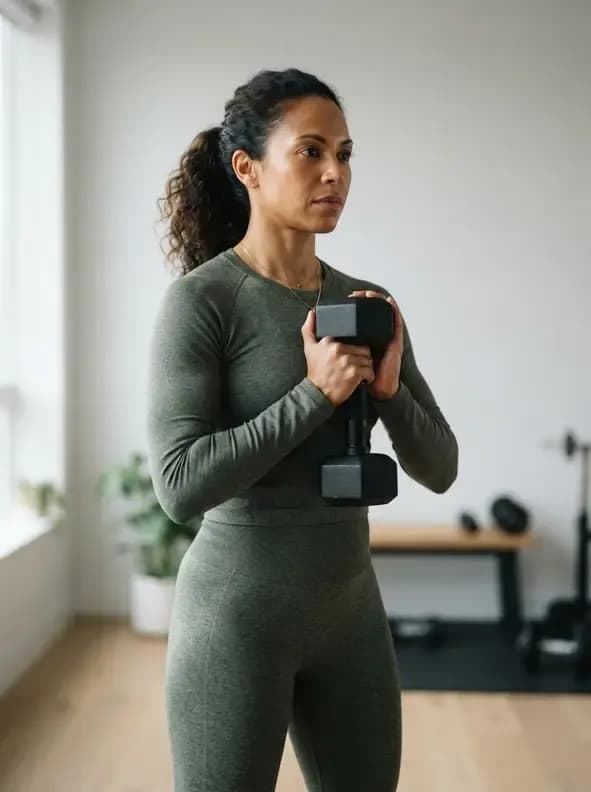
Ever feel like your squats just aren't quite right? Maybe your back aches, your heels lift up, or you wobble like you're balancing on a tightrope. It's a common struggle. What if there was one exercise that could teach you perfect squat form, build serious leg and core strength, and protect your back all at the same time? Enter the goblet squat.
"It’s more than just a leg exercise; it's a full-body tutor that fixes your form, builds your core, and protects your back all at once."
What is a Goblet Squat and Why Is It a Fitness Game-Changer?
The goblet squat is a foundational lower-body exercise where you hold a single weight—usually a dumbbell or kettlebell—vertically against your chest with both hands. Think of holding a heavy goblet, and you've got the idea. You then perform a squat while keeping the weight securely in place.
But why is it so special? For absolute beginners, it's the best teacher for learning proper squat mechanics. The weight in front acts as a counterbalance, making it much easier to keep your torso upright and sink deep into the squat. For experienced lifters, it’s a fantastic warm-up to activate the right muscles or a tough accessory exercise to build core stability and leg endurance. It’s an incredibly efficient movement that delivers a ton of benefits.
7 Key Benefits of Adding the Goblet Squat to Your Routine
Adding this one move to your workout can have a huge impact. It's not just another leg day exercise; it’s a tool for building a stronger, more resilient body from the ground up. Here are some of the biggest advantages:
- Builds Perfect Squat Mechanics: The front-loaded weight naturally encourages you to keep your chest up and sit back, correcting many common squatting errors without you even thinking about it.
- Enhances Core Strength & Posture: To keep the weight from pulling you forward, your abs, obliques, and lower back have to work overtime. This constant tension builds a rock-solid core that supports better posture in your daily life.
- Safer on the Lower Back: Because you stay more upright than in a traditional barbell back squat, there's less pressure and shearing force on your spine. This makes it a wonderfully back-friendly option.
- Full-Body Engagement: While your legs are doing the heavy lifting, your upper back, shoulders, and arms are working hard to hold the weight steady. It’s a sneaky full-body workout.
- Improves Mobility: The goblet squat allows you to safely explore a deep squat position, which can help improve flexibility in your hips and ankles over time.
- Incredibly Versatile: You can do it with a dumbbell, a kettlebell, or even a heavy backpack. It's an accessible exercise that can be done in a crowded gym or a small living room.
- Easy to Scale: Progress is simple. As you get stronger, you just pick up a heavier weight. It's a straightforward way to apply progressive overload for both beginners and advanced athletes.
How to Do a Perfect Goblet Squat (Step-by-Step Form Guide)
Ready to try it? Nailing the form is key to getting all the benefits. Follow these steps for a perfect, safe, and effective goblet squat.
- The Setup & Grip: Stand with your feet about shoulder-width apart, with your toes pointed slightly out. If using a dumbbell, cup one end of it vertically with both hands so it rests against your chest. If using a kettlebell, hold it by the sides of the handle (the 'horns'). Keep the weight 'glued' to your sternum throughout the entire movement.
- The Brace & Descent: Take a big breath deep into your belly and brace your core as if you're about to be punched. Initiate the squat by pushing your hips back slightly, then bend your knees to lower yourself down. Keep your chest held high—imagine showing off a logo on your shirt to someone in front of you.
- The Bottom Position & Ascent: Lower yourself until your hips are just below your knees. A great goal is to have your elbows gently touch the inside of your knees at the bottom. From there, drive powerfully through your entire foot (not just your toes or heels) to stand back up to the starting position. Exhale as you push back up.
What Muscles Does the Goblet Squat Work?
The goblet squat is a true team effort, recruiting muscles from your legs all the way up to your shoulders. Here’s a breakdown of who’s doing the work.
Primary Movers
These are the muscles doing the bulk of the lifting.
- Quadriceps: The big muscles on the front of your thighs. They are responsible for extending your knees as you stand up from the bottom of the squat.
- Gluteus Maximus: Your glutes are the powerhouse for hip extension, which is the main action of driving your hips forward and returning to a standing position.
Secondary Movers
These muscles assist the primary movers and provide stability.
- Hamstrings: Located on the back of your thigh, they help both with hip extension and stabilizing the knee joint.
- Adductors: Your inner thigh muscles, which help you control the position of your knees and contribute to hip extension.
Key Stabilizers
These unsung heroes are what make the goblet squat such a great core and posture-building exercise.
- Erector Spinae & Core: The muscles in your lower back, along with your abdominals and obliques, work isometrically (without moving) to keep your torso upright and stable.
- Upper Back & Shoulders: Your rhomboids, traps, and deltoids fire up to support the weight and keep it from pulling your chest forward.
Choosing Your Equipment: Kettlebell vs. Dumbbell for Goblet Squats
The two most common tools for a goblet squat are a kettlebell and a dumbbell. Both work great, but they offer slightly different experiences. Which one is right for you?
For beginners, a dumbbell is often easier to hold securely. You can cup the top end with both hands, providing a stable base. Kettlebells, held by the horns, have a unique center of gravity that can present a different stability challenge and is excellent for transitioning to other movements like swings.
Ultimately, both are fantastic tools. For those building a home gym, adjustable dumbbells can be particularly space-efficient and cost-effective, allowing you to gradually increase the weight as you get stronger.
Feature — Dumbbell — Kettlebell
Ease of Grip — Often easier for beginners to hold securely. — Can be awkward at first; requires more wrist stability.
Scalability — Adjustable sets offer excellent, incremental progress. — Requires buying new, heavier bells as you progress.
Versatility — Great for all traditional strength exercises. — Better for dynamic, ballistic movements like swings and cleans.
Footprint — Adjustable sets are very space-efficient. — A full set takes up significant space.
5 Common Goblet Squat Mistakes (And How to Fix Them)
Even with its form-correcting magic, a few bad habits can creep in. Here are the most common mistakes and how to fix them for good.
- Mistake 1: Leaning Too Far Forward. As the weight gets heavier, it's tempting to let it pull your chest down. The Fix: Keep the weight glued to your chest and puff your chest out proudly. Actively pull your shoulder blades back and down.
- Mistake 2: Knees Caving Inward. This is a common issue that puts stress on the knee joint. The Fix: Think about 'spreading the floor apart' with your feet as you squat. You can also try placing a light resistance band just above your knees to actively push against.
- Mistake 3: Heels Lifting Off the Floor. This often points to limited ankle mobility or a balance issue. The Fix: Focus on keeping your weight over the middle of your foot. As a temporary fix, you can place small weight plates under your heels to allow for a deeper squat while you work on your ankle mobility.
- Mistake 4: Not Squatting Deep Enough. Stopping high cuts the benefits short, especially for your glutes. The Fix: Focus on the cue of getting your elbows to touch the inside of your knees. If you can't, work on mobility or lower the weight until you can hit proper depth with good form.
- Mistake 5: Letting the Weight Drift Away. If the dumbbell or kettlebell moves away from your body, your lower back will take on too much strain. The Fix: Actively pull the weight into your chest. Imagine it's a permanent part of your sternum for the duration of the set.
Frequently Asked Questions (FAQ)
How much weight should I start with?
Start light! It's best to begin with just your bodyweight to master the movement pattern. Then, pick up a light dumbbell (5-10 kg) and focus entirely on perfect form. You can always add more weight later.
How many reps and sets are ideal?
For building strength and muscle, a great place to start is with 3 to 4 sets of 8 to 12 repetitions. Make sure the last couple of reps in each set are challenging but not impossible to complete with good form.
Is the goblet squat enough for leg growth on its own?
For beginners, absolutely. It's an amazing exercise for building a solid foundation. As you become more advanced, you may need to add heavier loads from exercises like barbell squats or leg presses for maximum muscle growth, but the goblet squat will always be a valuable tool in your arsenal.
Can I do them if I have bad knees?
For many people, the goblet squat is actually better for their knees than other squat variations because it promotes such good form. By keeping your torso upright, it helps distribute the load more evenly. However, everyone is different. If you feel pain, stop immediately and consult a doctor or physical therapist.
Your Next Step to a Stronger Squat
The goblet squat is more than just an exercise; it's a movement teacher. It's one of the safest and most effective ways to build a strong lower body, a stable core, and the confidence that comes with mastering a fundamental lift. Whether you're just starting your fitness journey or are a seasoned lifter looking to refine your technique, the goblet squat deserves a place in your routine.